
The gray wolf is usually seen as a wilderness species, an animal that needs vast expanses of habitat far from human concentrations, as well as sizable populations of large herbivores to prey upon. Yet many distribution maps, including one featured in the Wikipedia article on the species, shows gray wolves currently inhabiting some densely populated places. In the eastern Mediterranean region, for example, wolves are depicted as living in southern Lebanon, northern Israel, the West Bank, northwestern Jordan, and southwestern Syria (see the paired maps posted below). Other distribution maps show the gray wolf’s range as currently extending across the entire Arabian Peninsula, including the hyper-arid Rub’ al Khali, a large region of shifting sand dunes with little water and scant wildlife (see the second set of maps below).

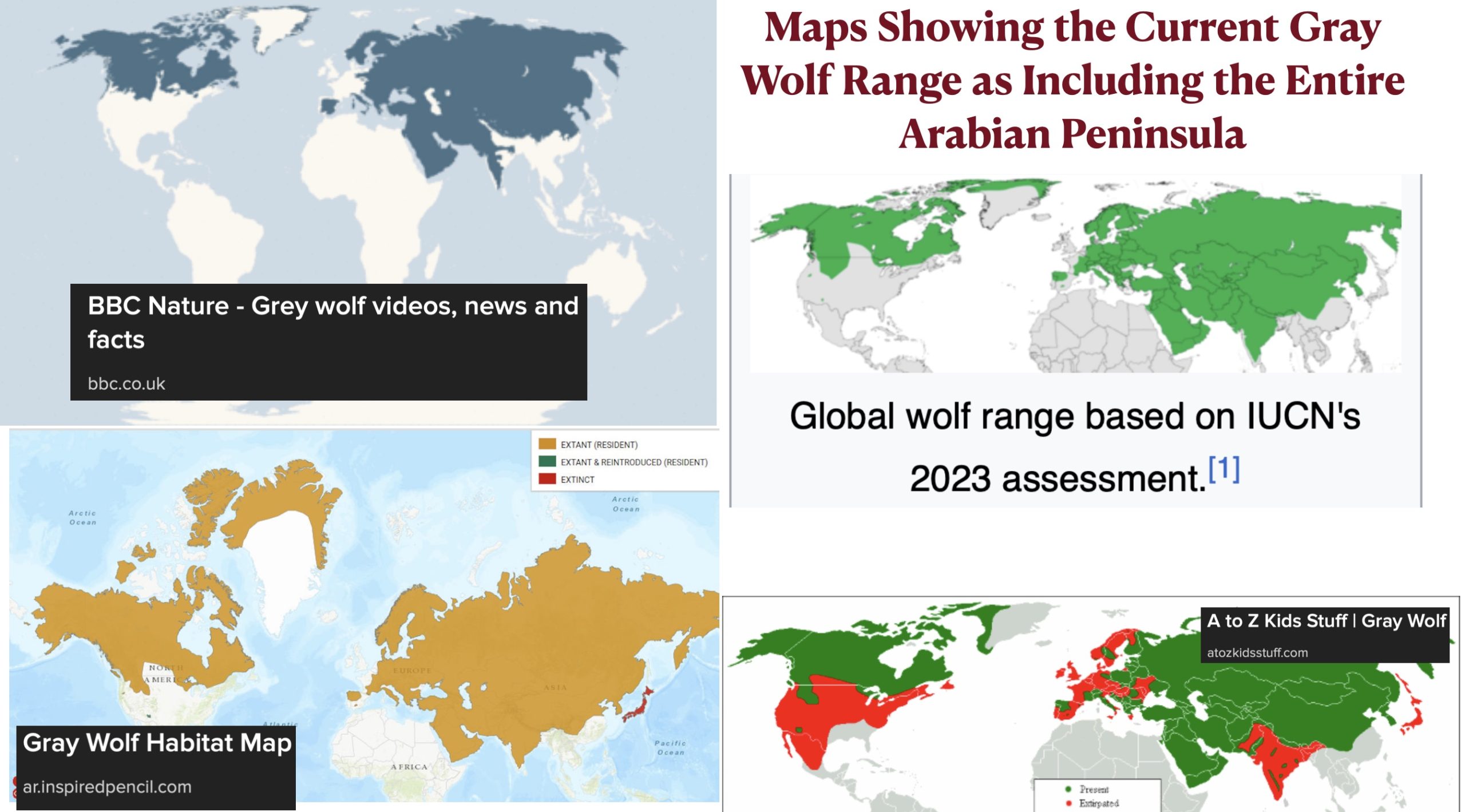
Such maps do not fit the common perception of wolf habitat and may therefore seem fraudulent. But although these maps exaggerate the range of the gray wolf, they also convey an element of truth that confounds expectations. The solution to this seeming paradox is found in the different habitat requirements of different wolf subspecies. The Arabian gray wolf (Canis lupus arabs) that inhabits some parts of the Arabian Peninsula is the smallest subspecies, weighing on average only 45 pounds (20.4 kg). In contrast, wolves in the American northwest generally weigh between 99 and 159 pounds (36 to 72 kg). Arabian wolves are thus closer in size to coyotes, which typically between 15 and 45 pounds (7 to 20 kg) and have reached 75 pounds (34 kg). Arabian wolves are also similar to coyotes in diet and social structure, typically hunting in pairs rather than in packs. As noted in the Wikipedia article on the animal:
Arabian wolves are mainly carnivorous, but also omnivorous and in some areas largely dependent on human garbage and excess products. Their native prey includes ungulates … as well as smaller animals like hares, rodents, small birds, and reptiles. They also eat cats, sweet fruits, roadkill, and other carrion. Opportunistically, almost any small animal including fish, snails, and baby baboons can be part of their diet.
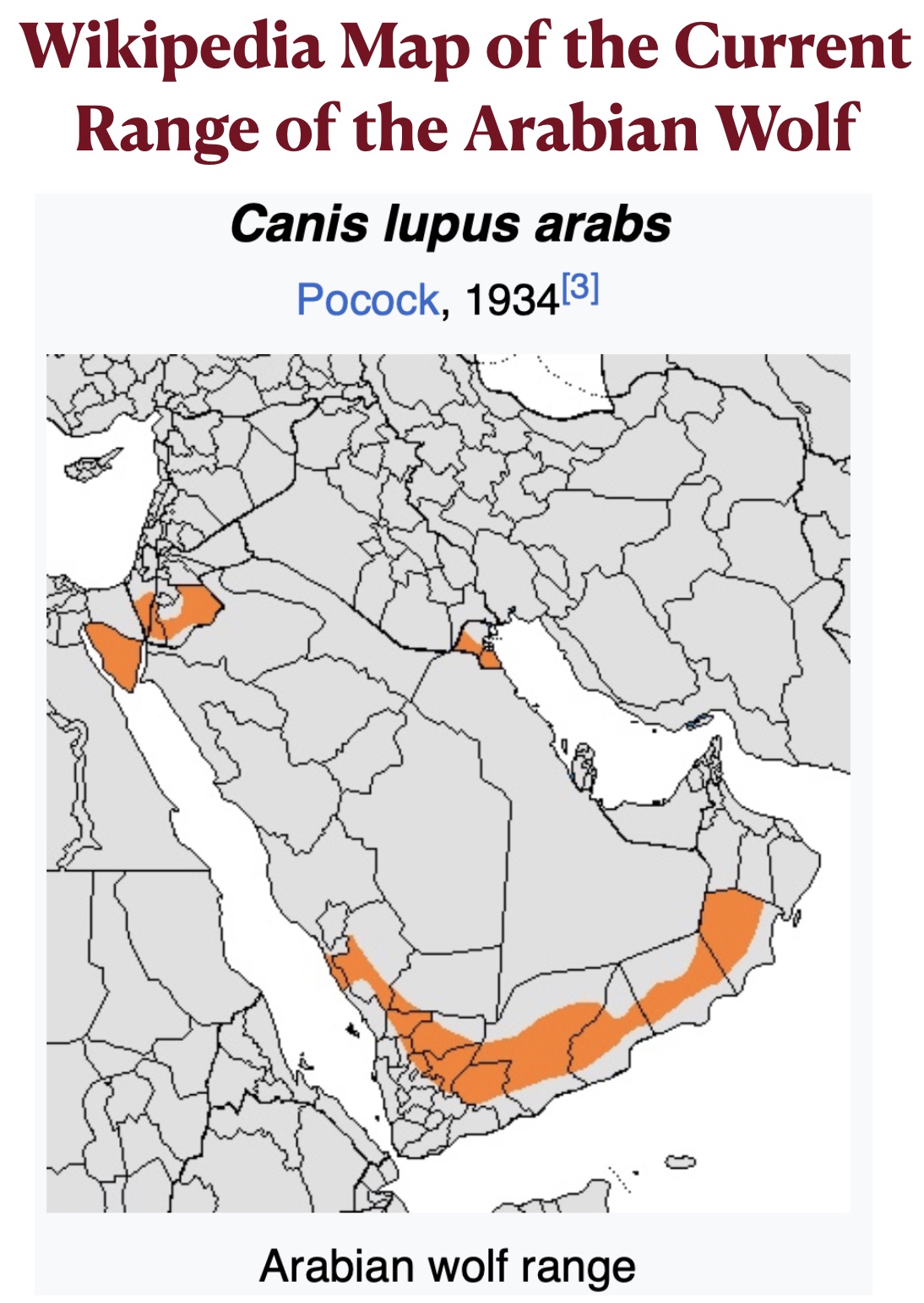
The reasonably accurate distribution map of the Arabian wolf found in the same article shows that its remaining populations are concentrated in the southern Arabian Peninsula, sandwiched between the more densely populated coastal areas and the more arid interior. Populations are also found in southern Israel, Jordan, and the southern Sinai Peninsula of Egypt. Numbers are relatively small, however, with Saudi Arabia supporting roughly 250-700 wolves, Jordan some 200, and Israel around 100 to 150. The Arabian wolf population of Israel is reportedly stable, while that of Jordan is said to be decreasing due to hunting pressure.
Remarkably, Arabian wolves also inhabit, or did until the current war, the densely populated Gaza Strip. A recent article on the wolves of Gaza outlines the situation as of 2023:
According to old Gazans, the Arabian Wolf was present in the Gaza Strip 7-8 decades ago, and after that its numbers decreased to zero. After the Israeli withdrawal from the Gaza Strip and the uprooting of its settlements in late 2005, dozens of Arabian Wolf and other carnivores crept intermittently through gaps in the border to the east of the Gaza Strip. The Arabian Wolf often arrives at night, looking for food, and it returns again in the morning hours to the Gaza Envelope. Many individuals have been captured or killed by Gazans at night using live traps “Maltash“, leghold traps “Fakh“, or even rifles and cartridges. Some healthy specimens have been sold and kept in cages at local zoos. Many plausible factors encouraged the infiltration of Arabian Wolves and other canids into the eastern Gaza Strip, such as the abundance of wildlife prey attracted by solid waste dumps, sewage treatment plants, and agricultural production activities of various crops, in addition to the abundance of animal pens and poultry farms.
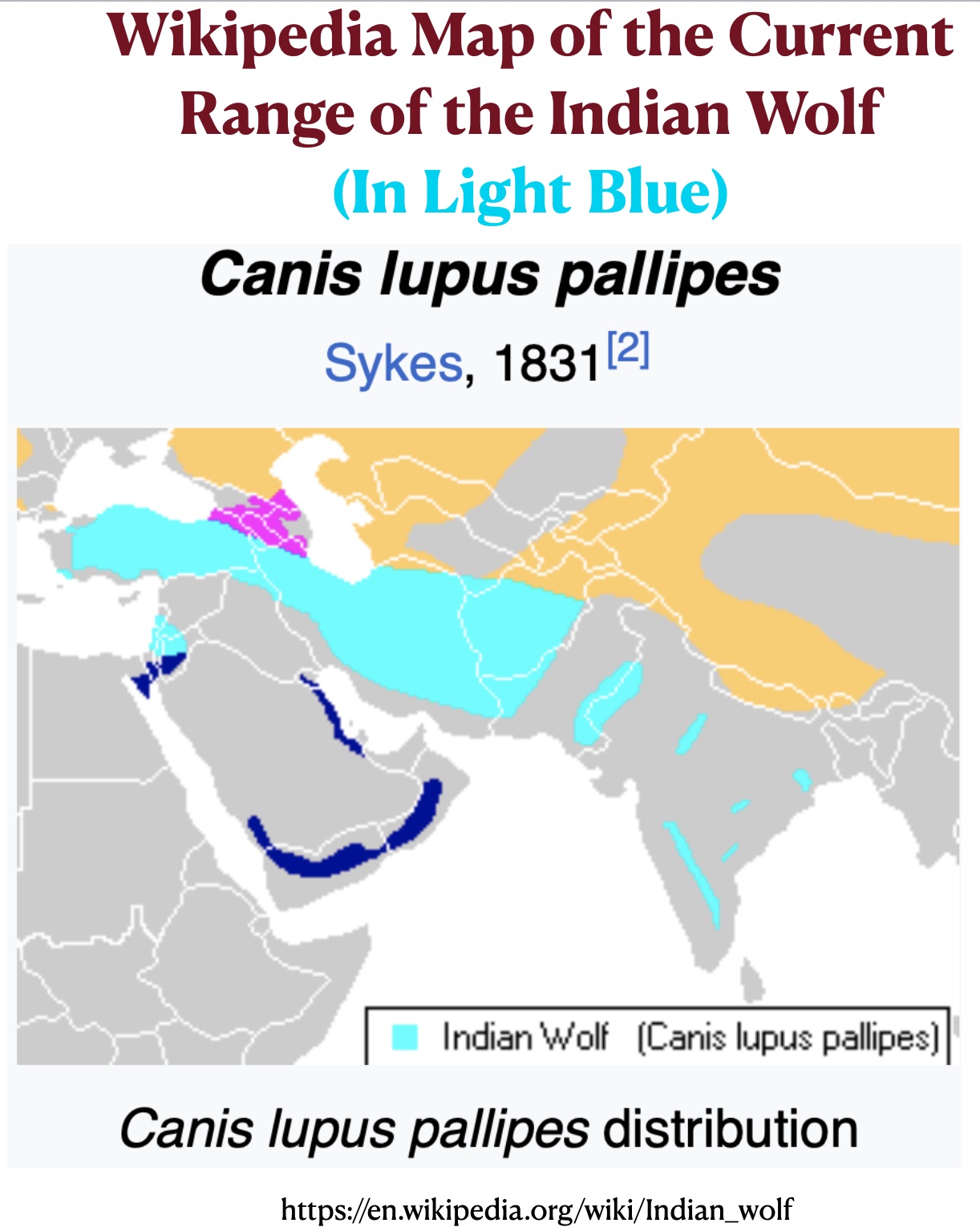
The wolves of northern Israel, Lebanon, and Syria are of a different subspecies, the endangered Indian wolf (Canis lupus pallipes). Indian wolves are intermediate in size between the Arabian wolf and the wolves of northern Eurasia and North America. Up to 7,000 Indian wolves inhabit the mountainous areas of eastern Turkey, but populations are smaller and more precarious in the eastern Mediterranean. According to the Wikipedia article on the subspecies, 80-100 Indian wolves live in the Golan Heights, where they are “well protected by the military activities there.” The same article also reports that “Israel’s conservation policies and effective law enforcement maintain a moderately sized wolf population, which radiates into neighbouring countries.”
It might seem odd to see military activities described protecting wildlife. Armed conflict is indeed associated with “detrimental effects on wildlife habitat and populations.” But the situation in the Golan Heights is not unprecedented. Korea’s so-called Demilitarized Zone, surrounded by heavy fortifications and littered with landmines, has become nothing less than an “accidental wildlife paradise.”