
The cardinal directions seem to be equivalent concepts and certainly appear that way on maps and globes. Everywhere on Earth, one might assume, the north/south axis is perpendicular the east/west axis, with the four lines that indicate the cardinal directions meeting at right angles. Everywhere on Earth, or so it would seem, east is defined as the direction in which the sun rises, while west is defined as the direction in which it sets.
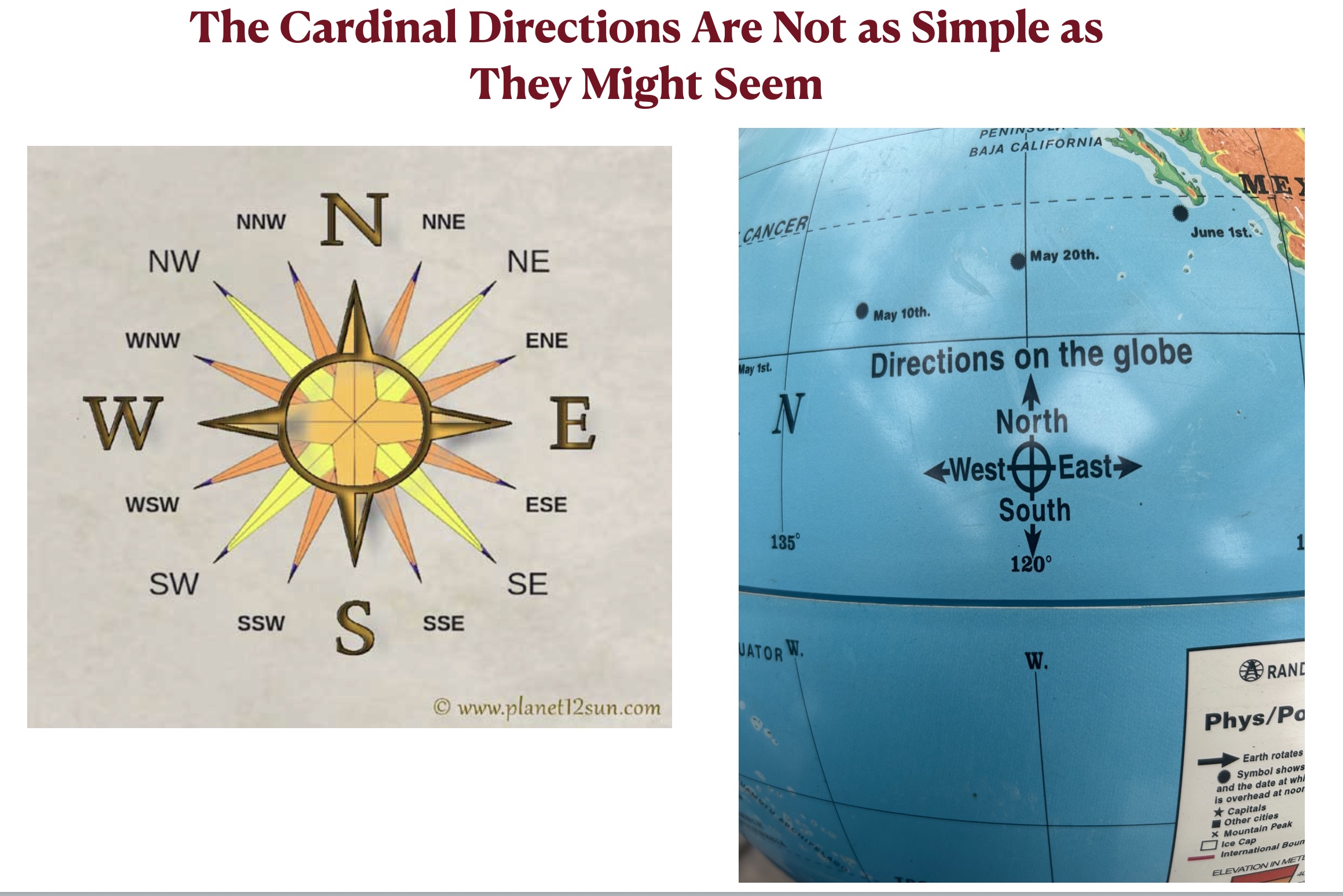
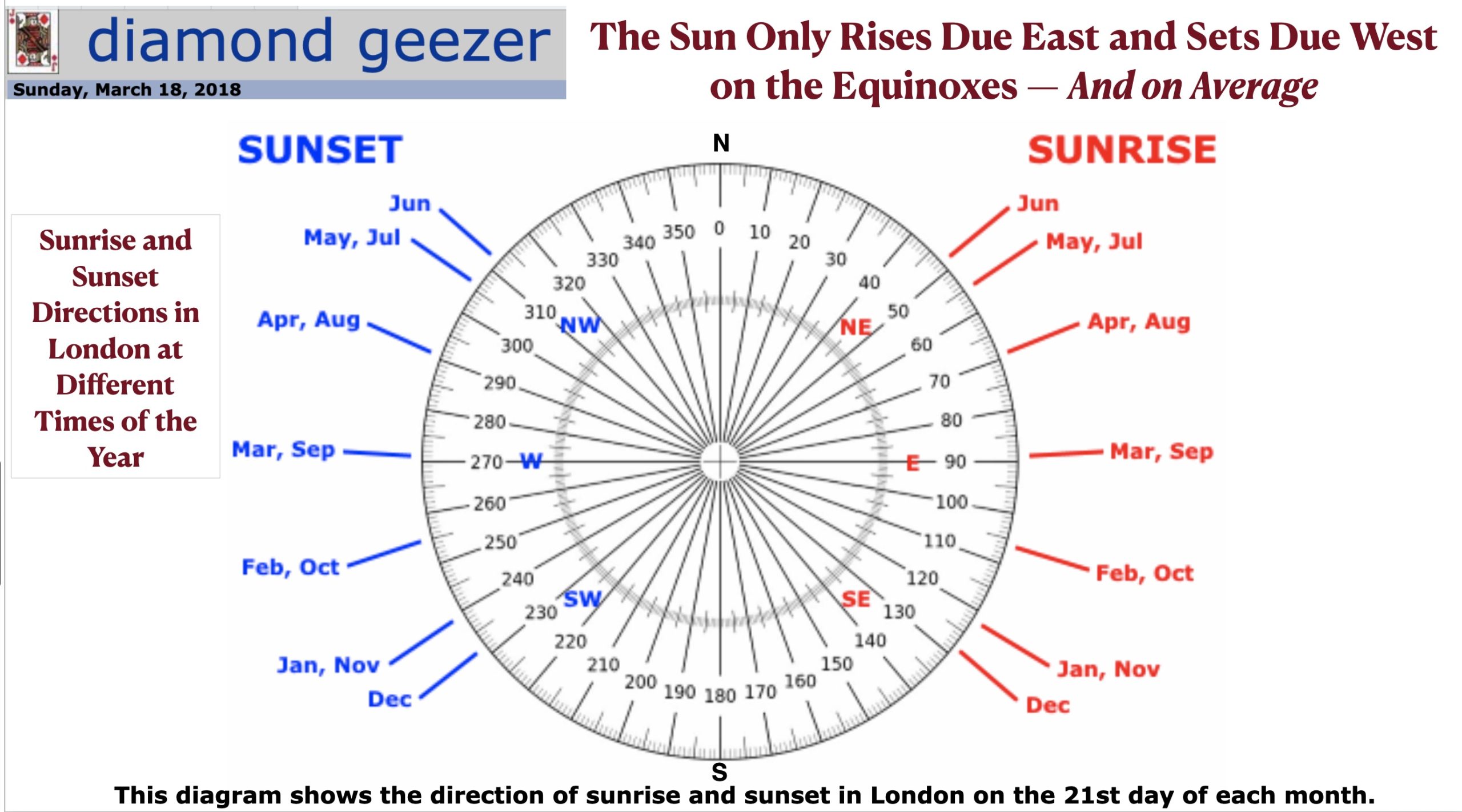
The actual situation, however, is more complicated. The cardinal directions, for example, collapse as you approach the poles. At the North Pole, all directions point “south,” while at the South Pole all directions point north. As can be seen in the diagram below, a few feet away from the North Pole the east/west directions, which follow latitude, form a tight curve, and thus do not meet the north/south axis at right angles. Daily sunrise and sunset, moreover, never occurs at the poles, as the sun remains above the horizon for half the year and below it for the other half. Equally significant, nowhere on Earth does the sun rise directly in the east or set directly in the west except at the two equinoxes (around March 20 and September 22). In the Northern Hemisphere’s midlatitude belt on the summer solstice (June 21), for example, the sun rises and sets well to the north of due east and west, while on the winter solstice it rises and sets well the south of the same directions. If its rising and setting positions are averaged out over the entire year, however, the sun does rise directly in the east and set directly in the west.

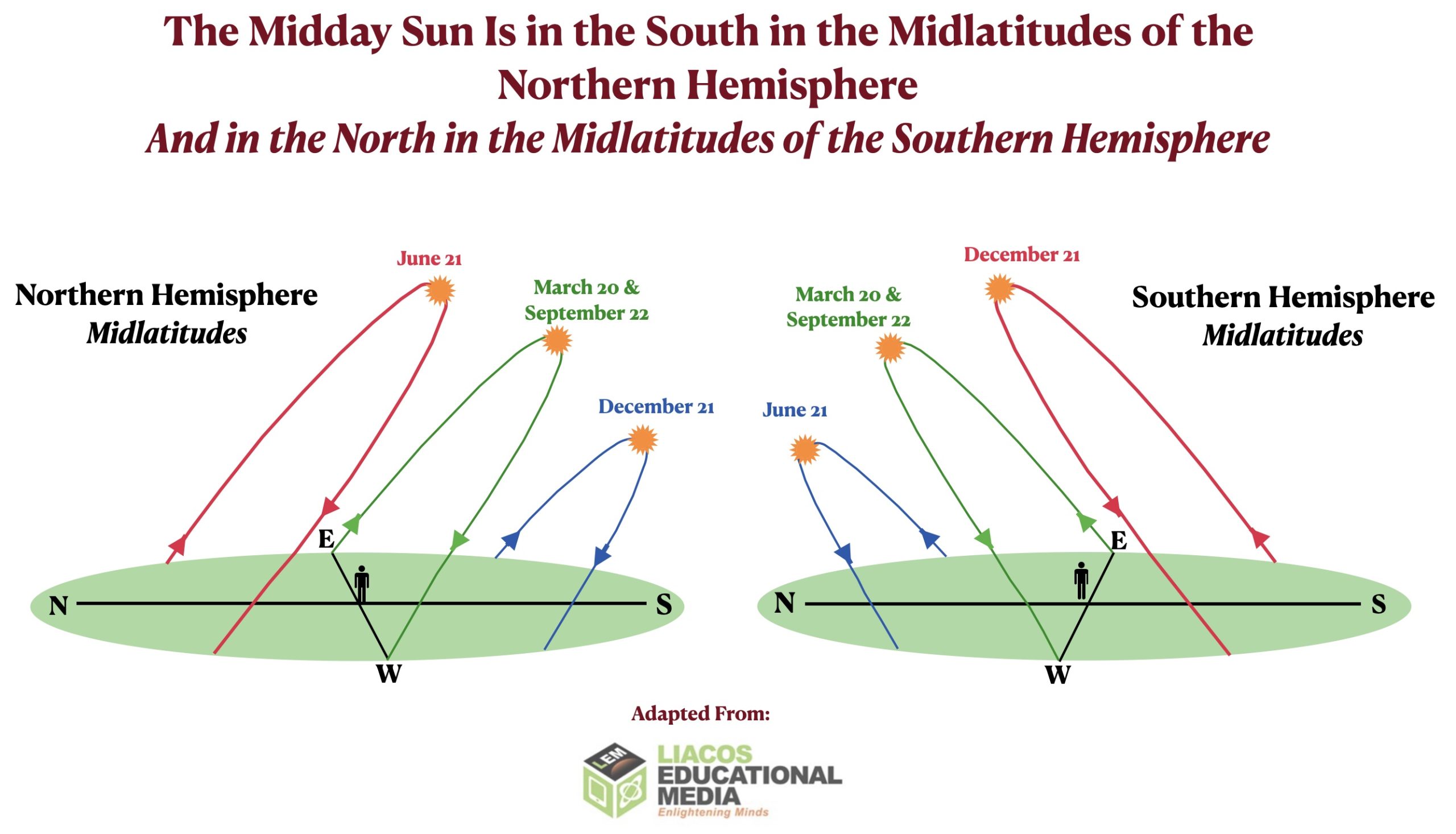
South and north can also be defined by the sun’s apparent position relative to the Earth. Throughout the contiguous United States (or “lower 48”), south is the direction of the sun when it reaches its highest position in the sky, halfway between sunrise and sunset, while the north is the opposite direction. But this definition only works in the midlatitude and arctic* belts of the Northern Hemisphere. In the corresponding zones of the Southern Hemisphere, the sun is located to the south when it reaches its highest position. In the tropics, in contrast, the midday sun is sometimes in the south and sometimes in the north, as has been explained in previous posts.
The crucial difference between the north/south directions and the east/west direction, however, is the absolute nature of the first pair and the relative nature of the second. North and south always and everywhere point to specific places, the north and south poles respectively (except at the poles themselves). East and West, on the other hand, are relative directions, as there is no easternmost or westernmost point on the planet. If you continue traveling straight to the east, you will eventually pass your starting point and find yourself to the west of it. From the global perspective, a given place can only be “west” or “east” relative to another place. The concept of “east” and “west” poles is absurd, although evidently enough people ask about them that detailed explanations are necessary (see the figure below).
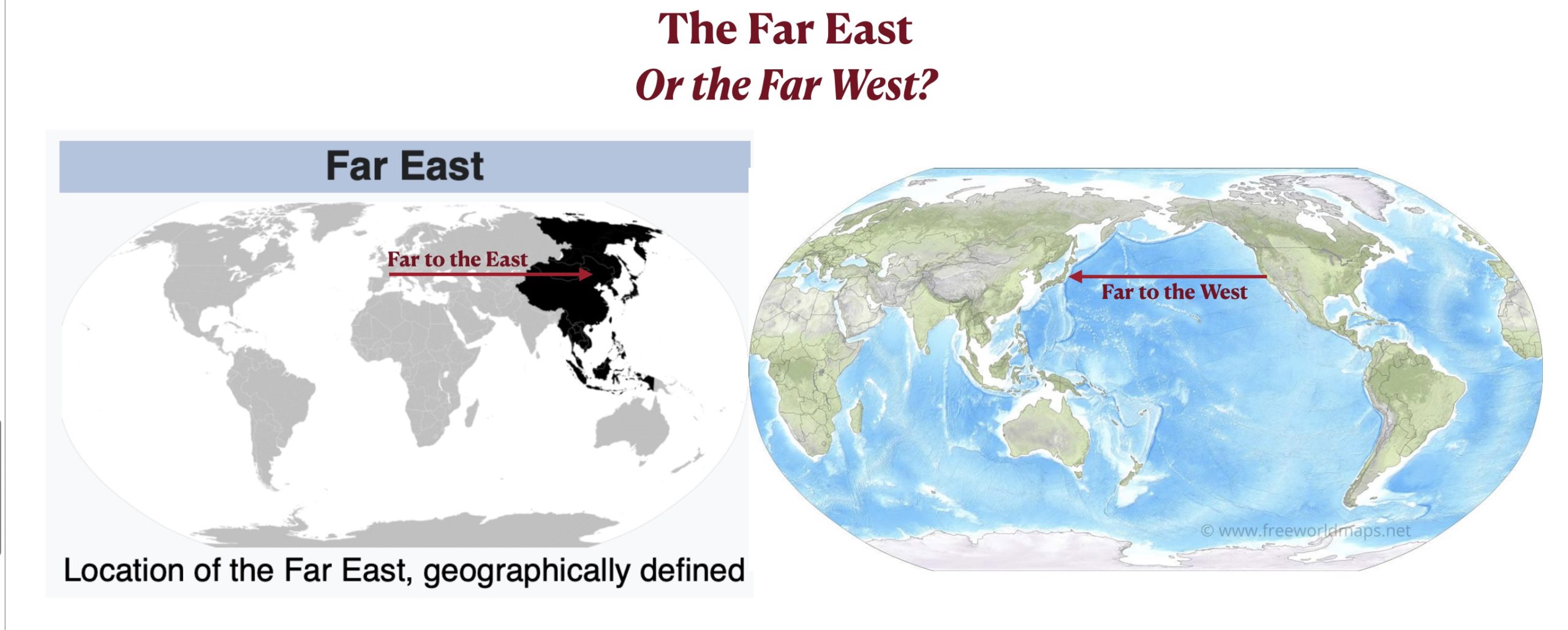
This relativity of the east-west direction can generate geographical confusion. China, Japan, and Korea are sometimes called the “Far East” because they are located far to the east of Europe, where the term originated. But from the perspective of the western United States, they are in the far west. By the same token, people often become confused about the location of the eastern Pacific Ocean, thinking that it must be near East Asia, another name for the Far East. But it is the western Pacific that is next to East Asia, while the eastern Pacific is adjacent to the west coasts of North and South America.
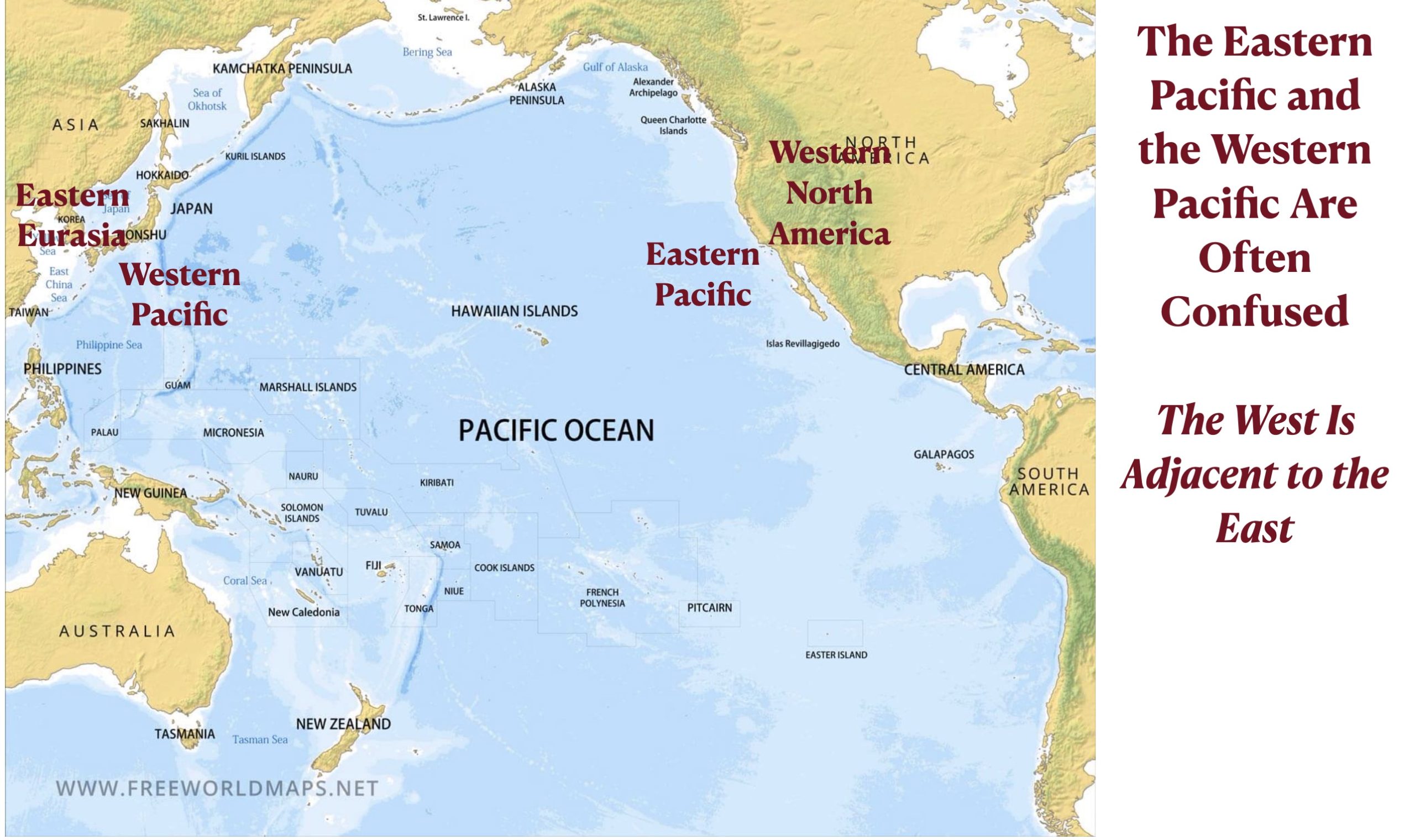
Despite the relative nature of the east/west directions, east is always the general direction of sunrise (except at the highest latitudes), while west is always the general direction of sunset. And despite the absolute nature of the north/south direction, north and south indicate opposite orientations toward the sun in the northern and southern hemispheres. In the Northern Hemisphere, south is the direction toward higher sun angles and increased solar radiation, whereas in the Southern Hemisphere north is that is the direction toward higher sun angles and increased solar radiation. The key difference is the direction toward the Equator, which is south in the northern half the world and north in the southern half.
*It does not, however, work at the poles, where the sun angle does not change over the course of a day.