(This is the seventh post in a series aimed at helping parents home-school their children.)
As was noted in the previous post, hemispheres are created by conceptually slicing a globe through its center. The dividing line between the two hemispheres forms a “great circle,” meaning that it goes around the globe’s circumference. The Equator is thus a great circle, as is any line of longitude, such as the Prime Meridian, combined the line of longitude on the opposite side of the world (longitude will be covered in detail in a later lesson). If you tie a string snugly around any sphere, you can move it into any number of positions, all of which are great circles. On the globe, lines of latitude other than the equator “go around the world” in one sense, but they do not go around its circumference and are therefore not great circles (latitude will also be covered in detail in a later lesson). The most significant practical aspect of a great circle is in finding the shortest route between any two places on Earth, as it always follows the course of a great circle.
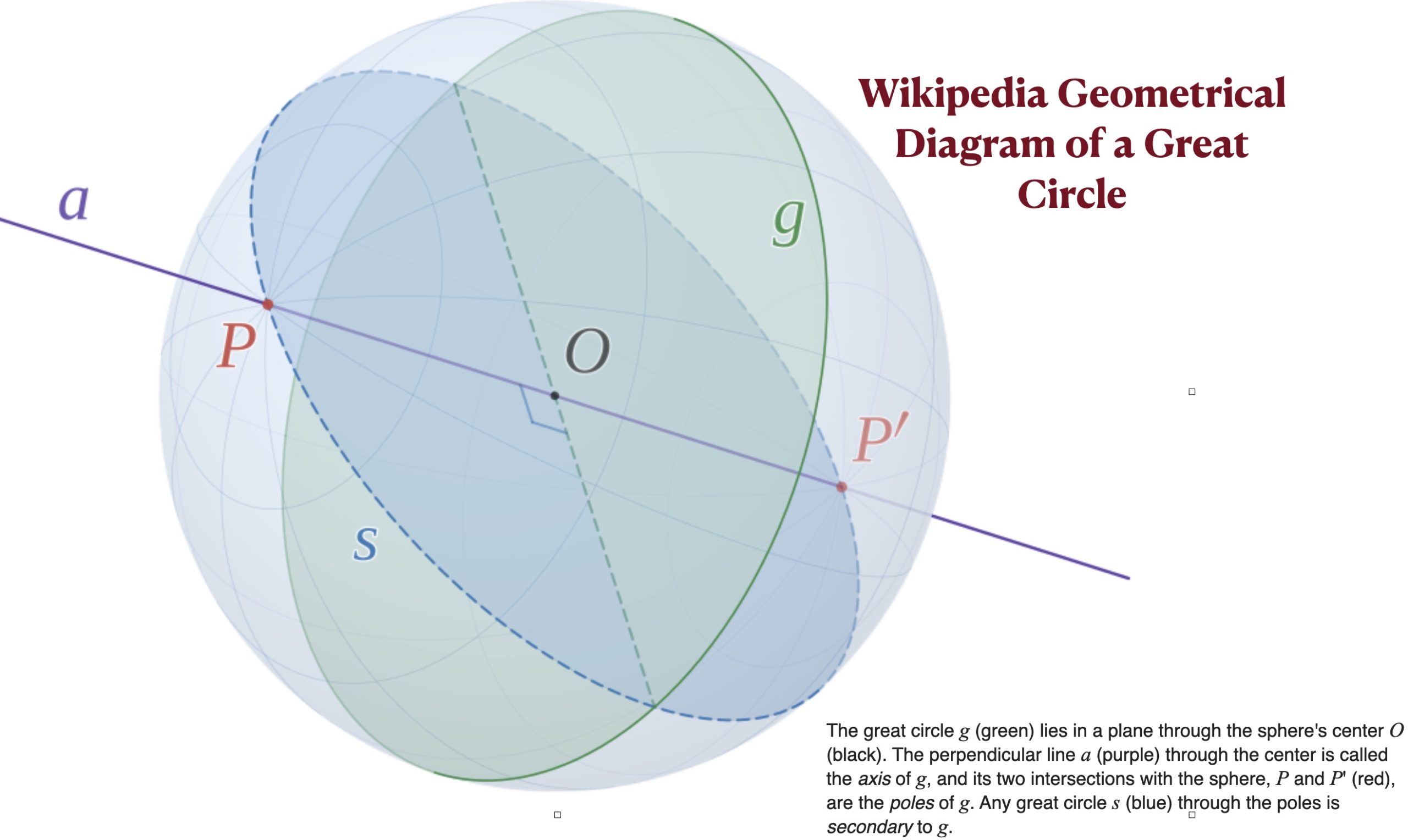
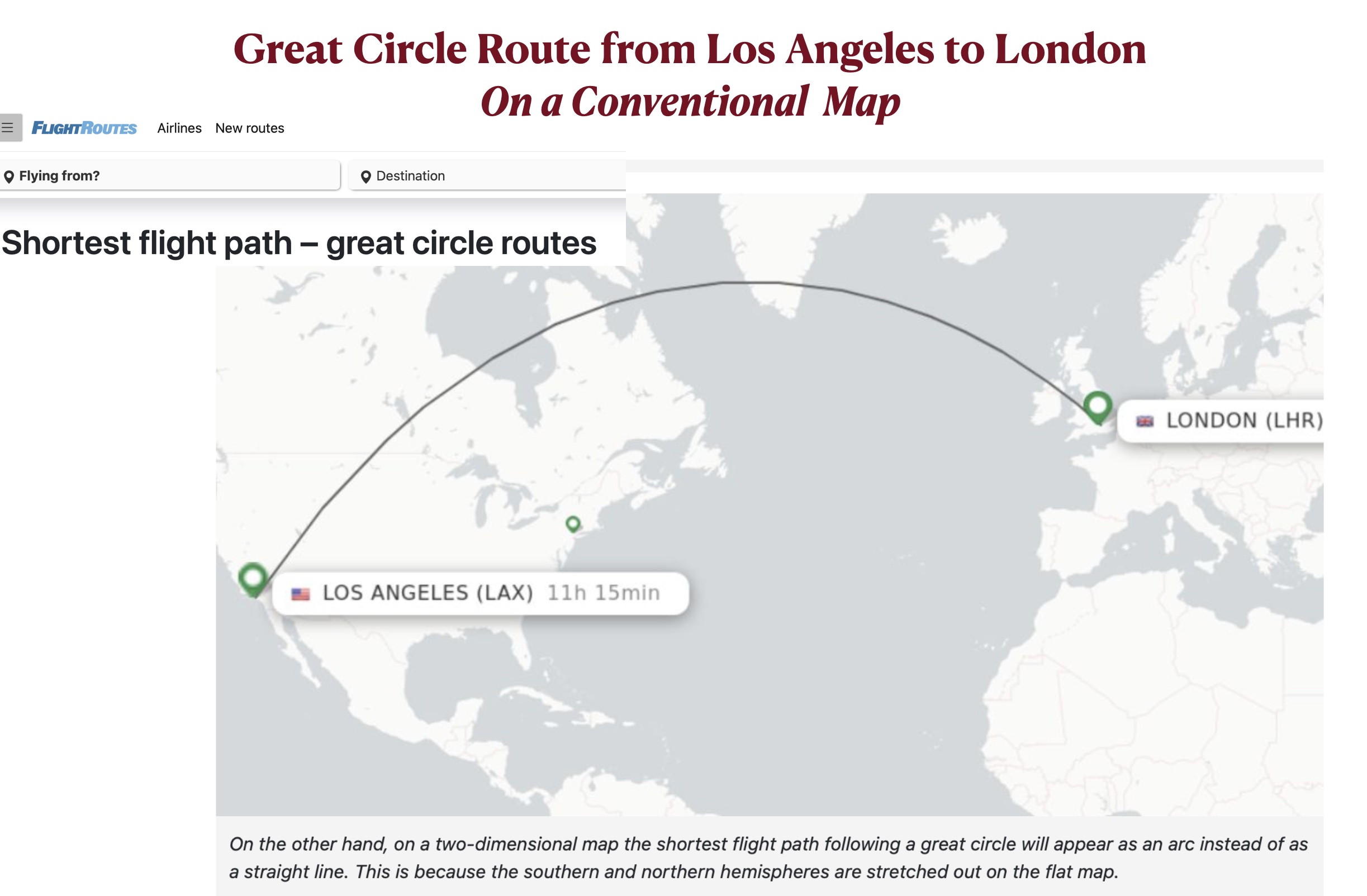
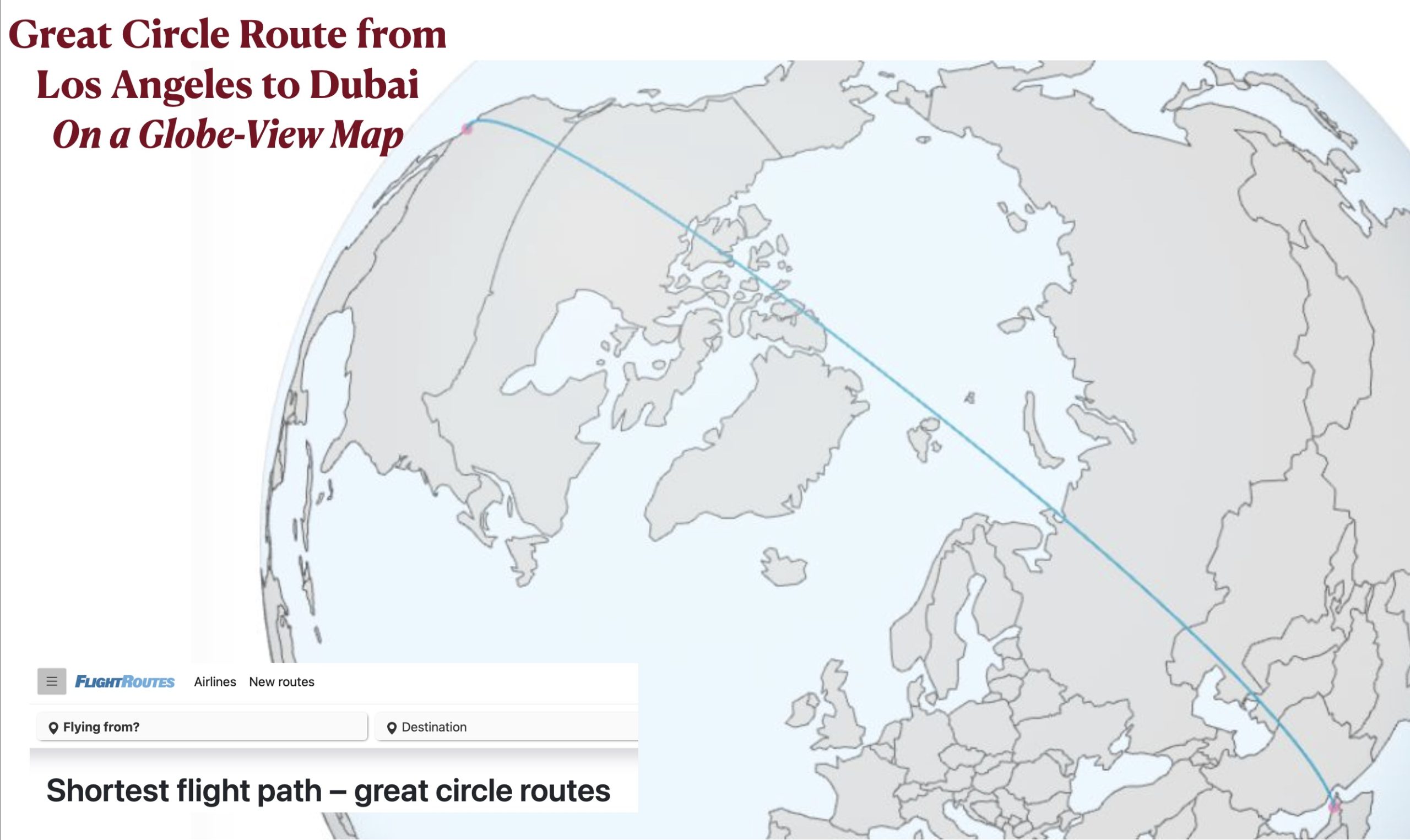
The concept of the great circle helps solve a seeming mystery. When people fly from the west coast of the United States to Europe, they often expect to travel in an eastward direction, as Europe is located to the east. It certainly looks like that would be the most direct route on a typical world map. As a result, first-time travelers to Europe can be surprised to find themselves flying far to the north, going over the icecap of Greenland. But you can easily see why a flight would take this path by looking at a globe or a globe-view map. A website called Flight Routes has an excellent article, “Shortest flight path – great circle routes,” that has some useful maps on this topic, such as those posted below.
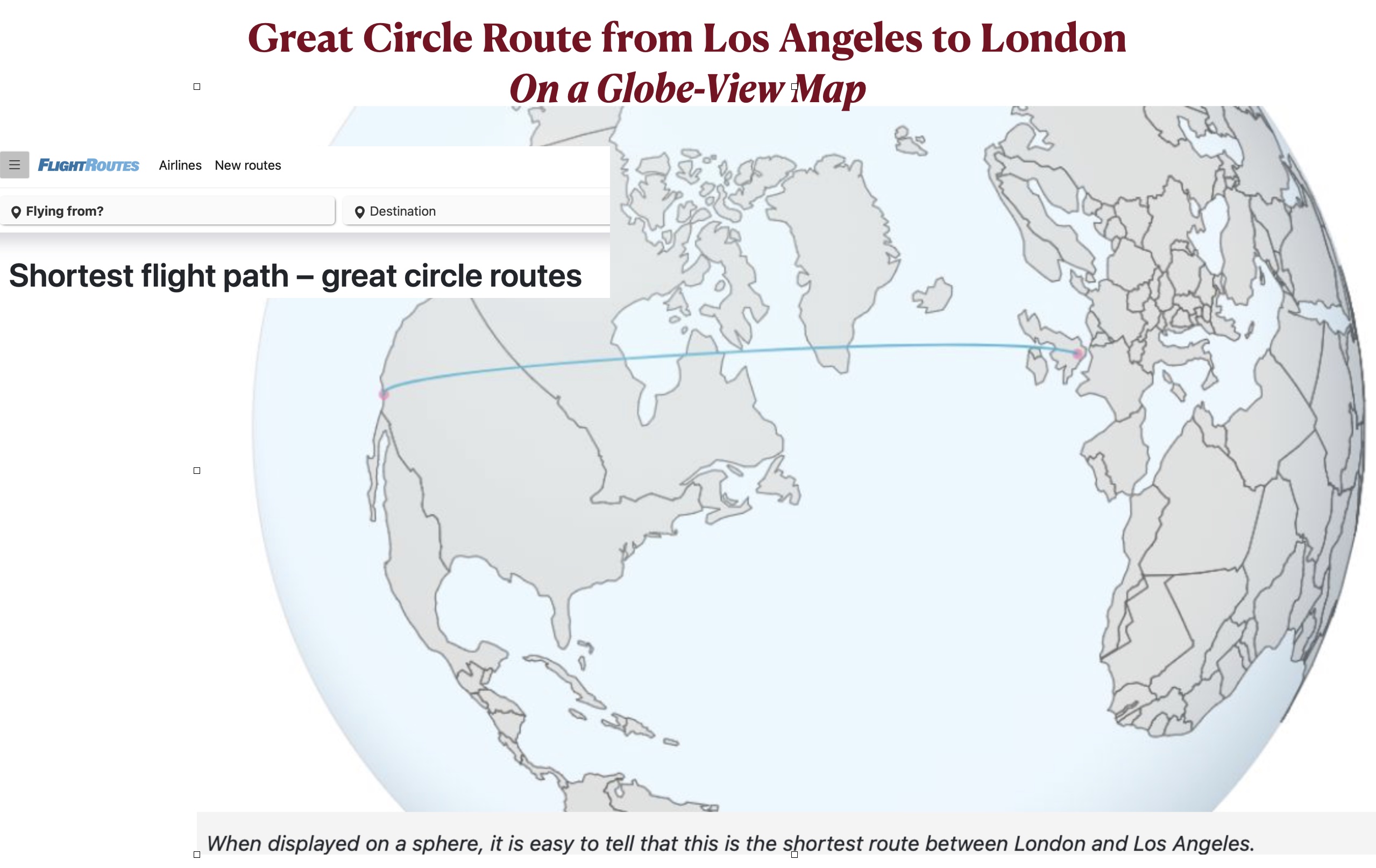
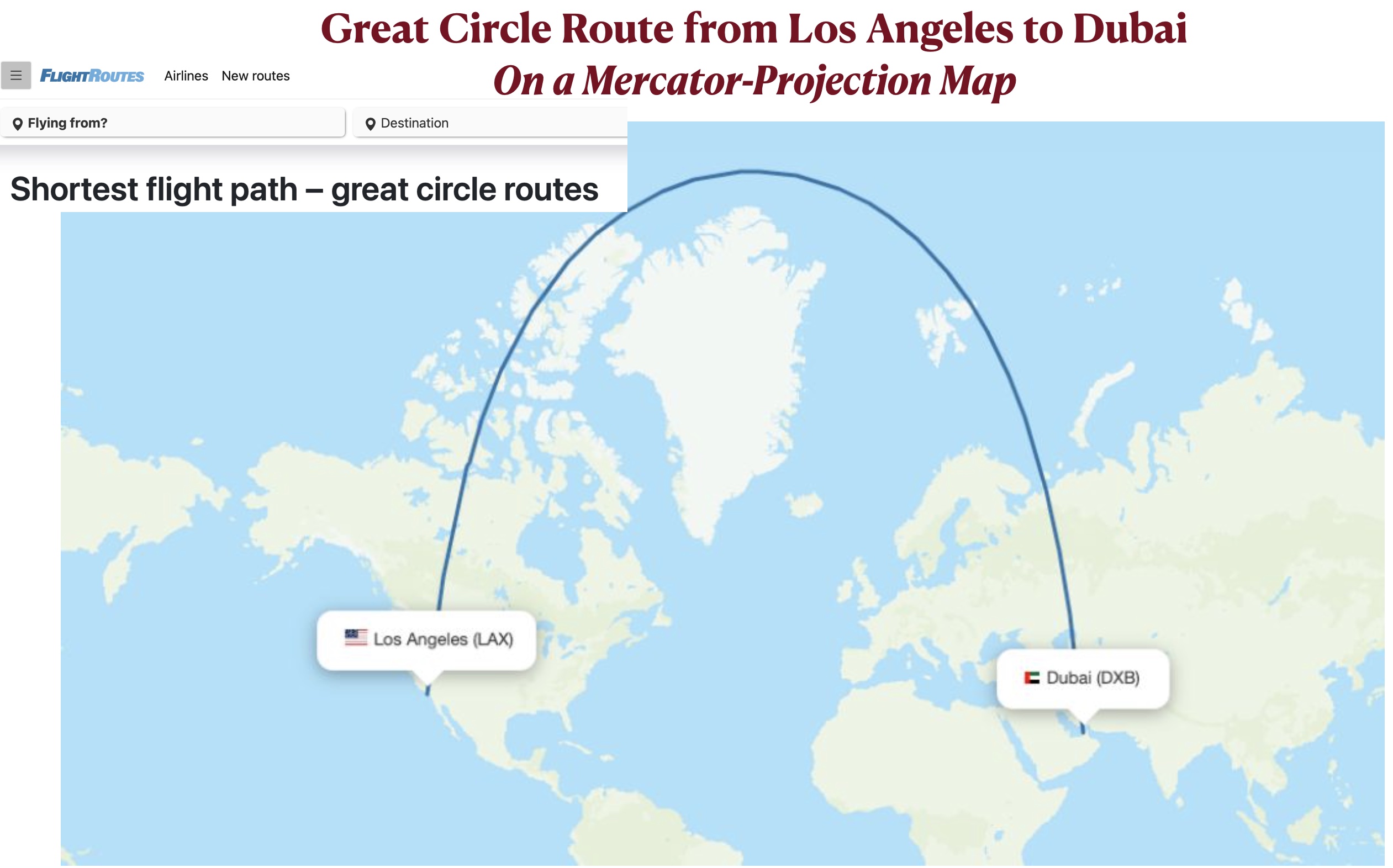
Even experienced travelers may be surprised to learn that the most direct route from Los Angeles to Dubai does not pass over Greenland but rather goes to its north. I certainly was. But as the Flight Routes maps posted below shows, this is indeed the path of a great circle.
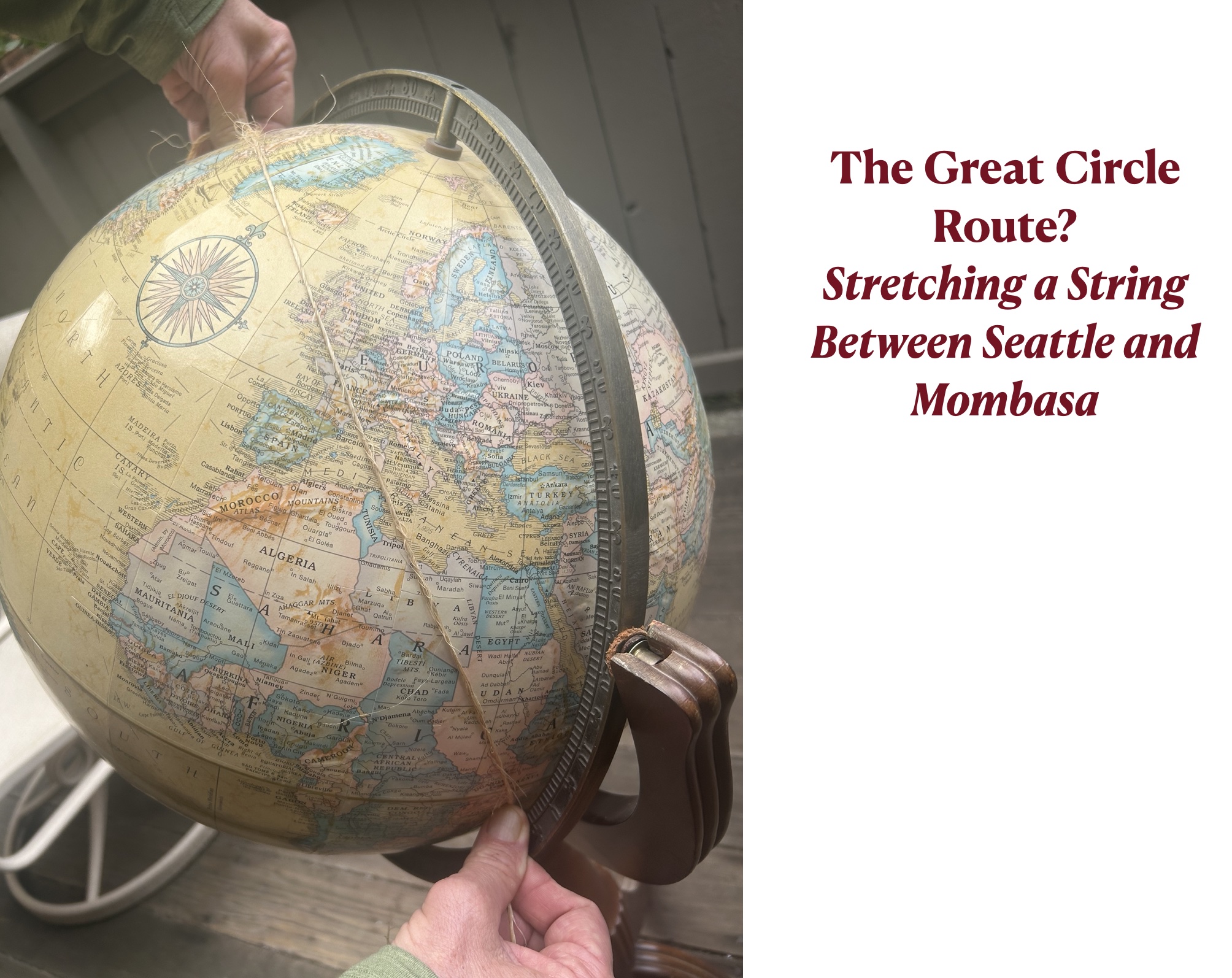
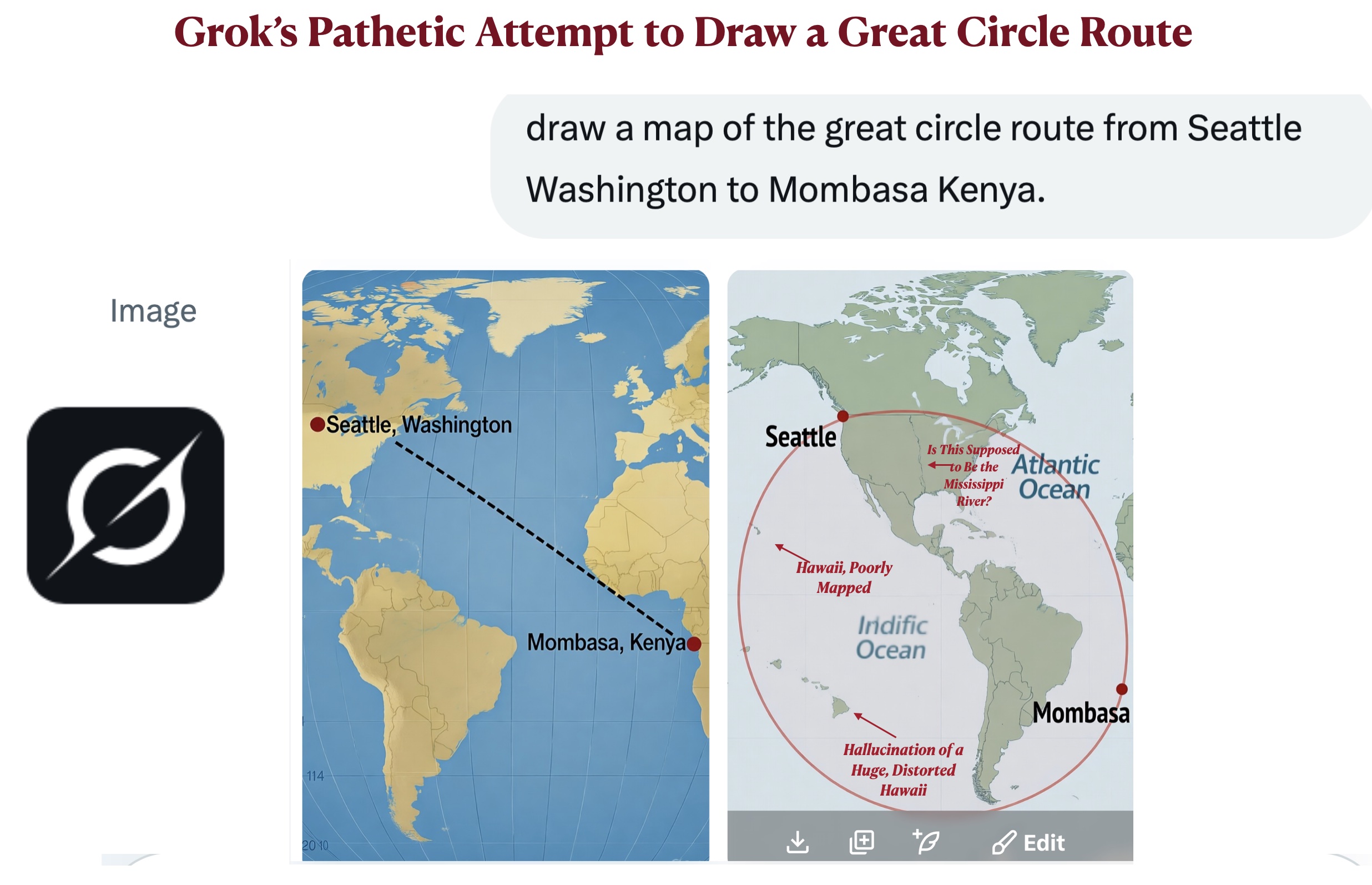
When playing around with a string and a globe, I was also surprised to see that a great circle route from Seattle to Mombasa (in Kenya) passes over Greenland. At least this is how it seemed in my simple experiment, as I could not be sure that my string was stretched as tautly as possible and thus followed the most direct path. I decided to test this finding with artificial intelligence (AI), using Grok because of its ability to quickly generate graphs and other images. What I learned was that in this instance, AI – or at least Grok – delivers nothing but artificial idiocy. Not only does it have no knowledge of a “great circle route,” but it apparently cannot even place Mombasa or Seattle in their correct locations. One of the maps that it produced put Mombasa just off the coast of the border between DR Congo and Angola, and the other placed it in the middle of the South Atlantic. The depiction of Hawaii in the second map is especially amusing. This experience makes me wonder if AI is in general poorly equipped to handle mapping questions and exercises.