
(This is the fifth post in a series aimed at helping parents home-school their children.)
After having covered the Earth’s daily rotation, it is time to consider the tilt of its axis. Here a little basic geometry is necessary, focused on angles and their measurement, along with orientations such as “vertical,” “horizontal,” “perpendicular,” and “parallel.” In the United States, this material is usually not introduced until the fourth or fifth grade. For younger children, simpler terms such as “straight up and down” can be used.
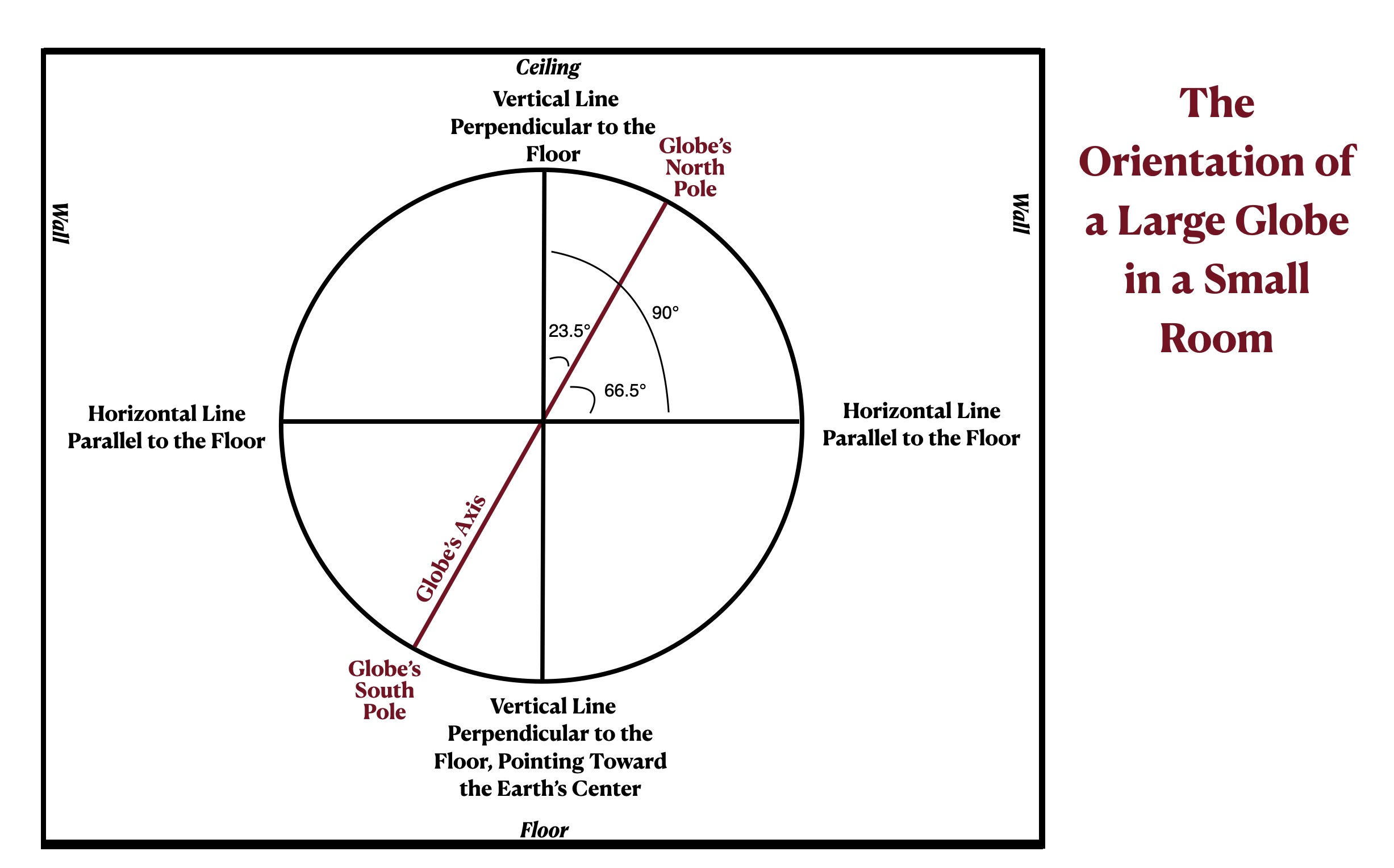
The 23.5° [1] tilt of the Earth’s axis is extremely important because it largely determines the march of the seasons and the division of the world into climate zones. But what exactly does “tilt” means in this context? “Tilt” must be relative to something else; if our planet was alone in the universe, the idea of its axis “tilting” would be meaningless. It is a different matter, however, with a globe located on Earth, as in this case gravity is the defining feature. A globe’s axis tilts 23.5° away from a vertical line that passes through its center, and the vertical orientation is defined as one pointing toward the center of the Earth. As can be seen in the image posted below, the globe’s axis forms a 66.5° angle with a horizontal line perpendicular the vertical line that also passes through the Earth’s center. As we will see in later lessons, these two angles, 23.5° and 66.5°, are geographically significant. As lines of latitude, they define the tropics of Cancer and Capricorn and the Arctic and Antarctic Circles respectively.
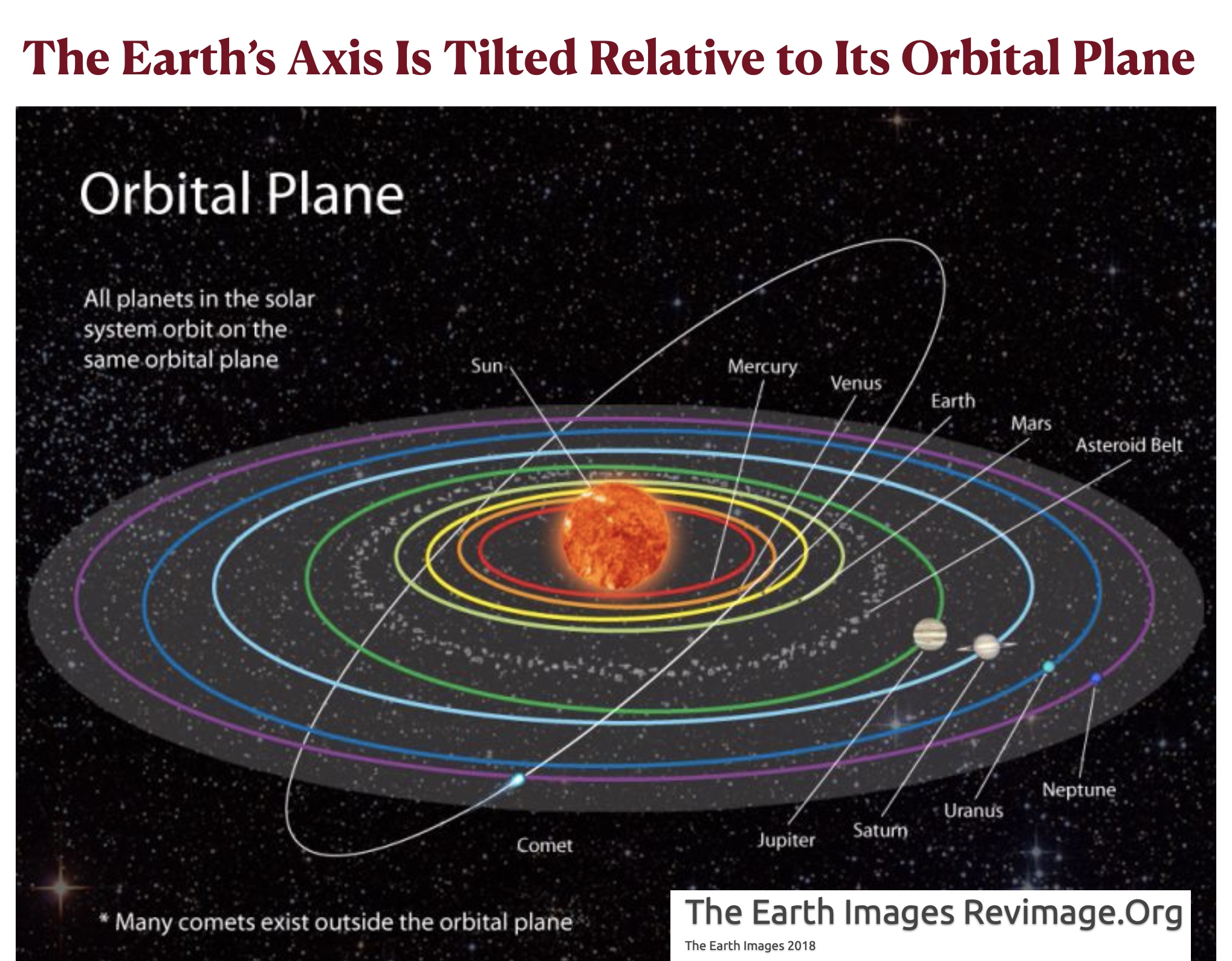
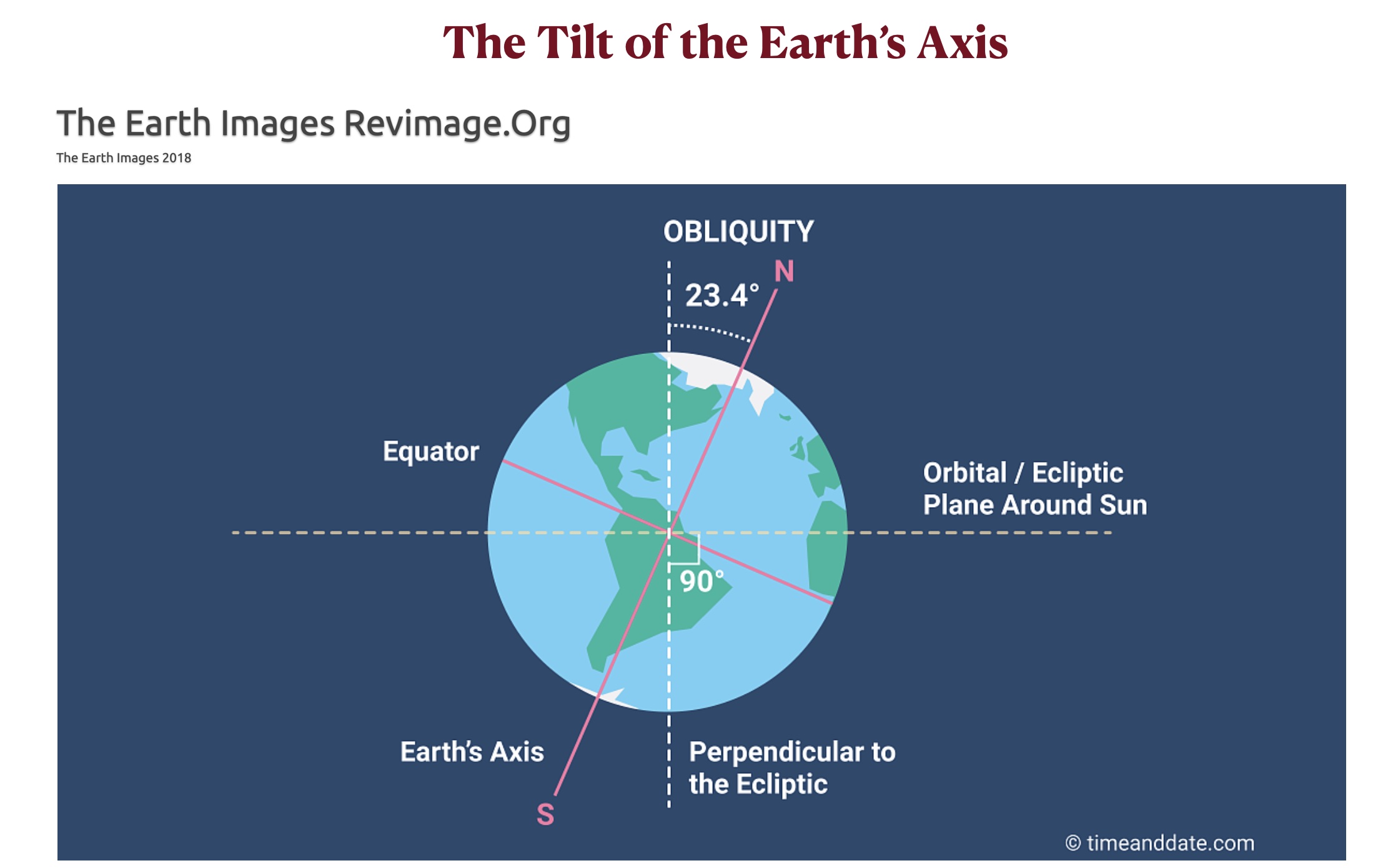
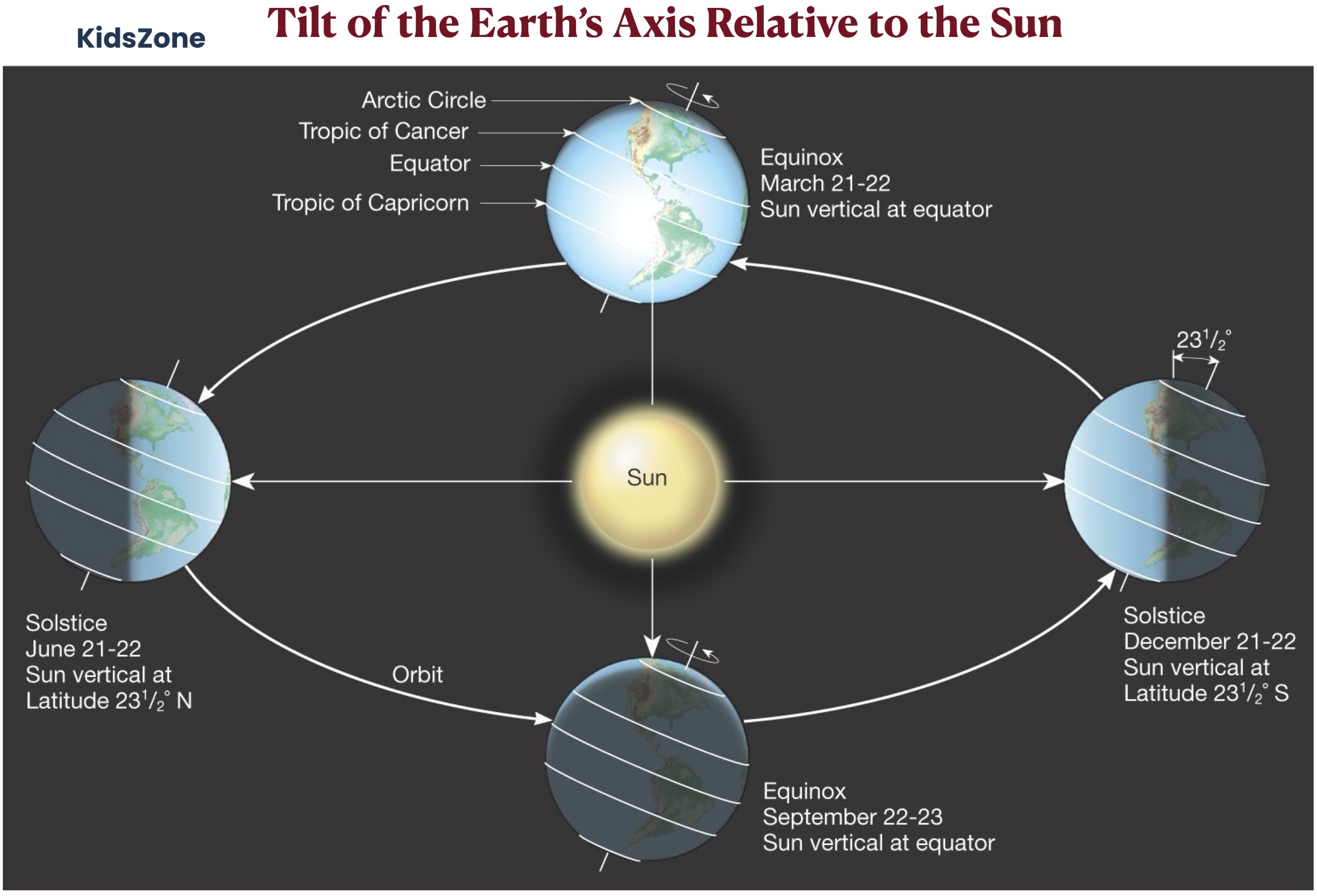
Unlike the tilt of a globe’s axis, that of the Earth cannot be defined in relationship to gravity. Instead, it is defined in relation to the imaginary plane on which the Earth orbits the sun, which is technically called the ecliptic. The Earth’s axis is tilted 23.5° from an imaginary line perpendicular to this orbital plane. Because the axis remains pointing in the same direction as it moves along the ecliptic place, its orientation with respect to the sun varies over the course of a year. On the Northern Hemisphere’s summer solstice in late June, the North Pole leans toward the sun a 23.5° angle, while on the winter solstice in late in December it leans away from the sun at a 23.5° angle.
Another demonstration with a globe and a flashlight in a dark room is useful here. Hold the globe while standing behind it, with a student in the center of the room pointing a flashlight toward it, representing the sun. Make sure that the top of the axis is on your lefthand side, neither pointing toward nor away from the light. This position represents the spring equinox, which occurs around March 20. If you rotate the globe, everyone should be able to see that the northern and southern hemispheres receive the same amount of light over the course of a day. Next, slowly walk to your right in a circular direction around the “sun,” making sure not to twist the globe and thus change its orientation. Instruct the student holding the flashlight to remain stationary but keep the light pointed toward the globe. When you have gone one quarter of the way around the “sun,” the North Pole will be leaning toward it. If you rotate the globe, everyone should be able to see that the Northern Hemisphere now receives more light than the Southern Hemisphere. The South Pole and the whole southern polar region will remain in the dark as the globe spins, whereas the North Pole and the entire northern polar region will remain in the light. This position represents the Northern Hemisphere’s summer solstice, which occurs around June 21. After another quarter turn around the light, the axis will again be in a neutral position, not oriented toward or away from the light. This position represents the fall equinox, which occurs around September 22. If you walk another quarter turn, the South Pole will be oriented toward the light. This position represents the Northern Hemisphere’s Winter Solstice, which occurs around December 21.
Later lessons will explain in more detail how these different orientations of the Earth’s axis relative to the sun determine the changing seasons and the world’s climate zones. But at this point you might want to briefly mention the importance of the tilt. If the Earth’s axis had a vertical orientation relative to the orbital plane, we would have no seasons, with average weather conditions being the same throughout the year. If the axis had a significantly greater tilt, seasonal differences would be extreme, with much of the world experiencing scorching summers and brutally cold winters.
[1]. The more precise number is 23.44°.