
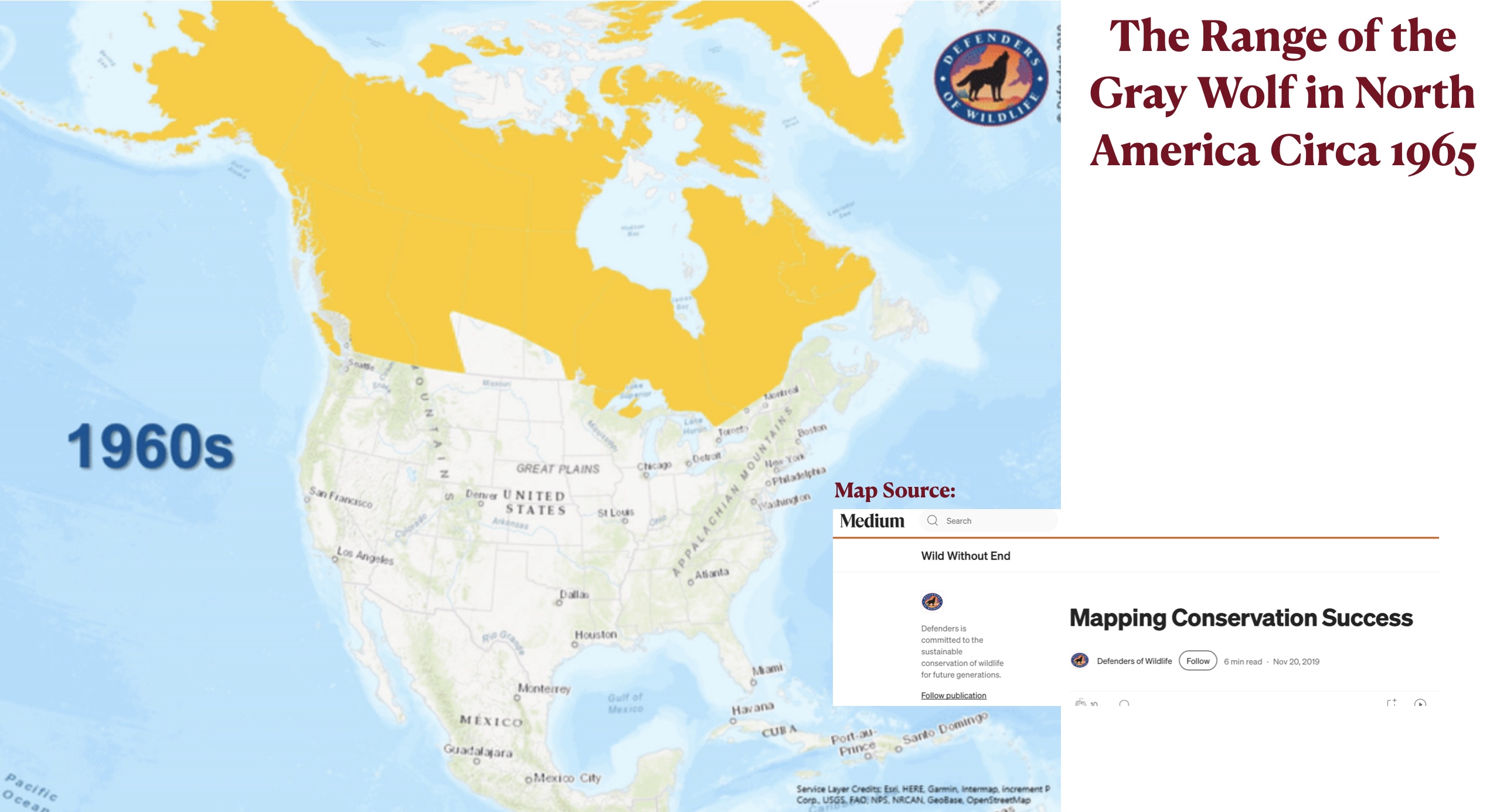
As discussed in the previous post, the gray wolf has made a remarkable but controversial recovery in Europe. The same is true in the United States. In the mid twentieth century, wolves were found only in Alaska, far northeastern Minnesota, and the western half of Michigan’s Upper Peninsula. A few may have lived in northern Wisconsin, but the state’s Department of Natural Resources claimed that the species had been locally extirpated by 1960. The western U.S. was essentially without wolves. The map posted below shows the range of the gray wolf terminating precisely along the U.S.-Canada border in western North America in the 1960s. Using a political border to delimit the range of a species is usually a lazy and misleading expedient, but it is probably appropriate here. At the time, wolves living in mountainous areas of southern British Columbia and Alberta occasionally crossed the border, but breading packs had been systematically eliminated from the western United States.
Wolves began to return to the western U.S. in the 1980s. In 1979, a lone female was encountered near Glacier National Park, and two years later she evidently mated with a migrant male. The so-called Magic Pack that they formed quickly expanded, forming the nucleus for wolf repopulation in northwestern Montana. In the 1990s, wolves were intentionally reintroduced into Yellowstone National Park, located mostly in northwestern Wyoming. Enjoying federal protection as an endangered species in all U.S. states but Alaska and Minnesota, wolves continued to expand their range and numbers over the next several decades, mostly through natural population increase and dispersion. Captive breeding programs for the smaller and almost extinct Mexican subspecies allowed its reintroduction into the mountainous area along the Arizona-New Mexico border.
Wolf numbers and ranges in the United States are carefully tracked by wildlife managers, allowing the creation of reasonably accurate distribution maps. Synthesizing spatial information from all the maps I could find and using numerical data from a Wildlife Informer article, I have mapped the distribution of wolves in the U.S. as of 2024 (see below). As can be seen, Alaska and the Lake Superior region in the upper Midwest still support the largest populations. In the western “Lower 48,” Montana and Idaho stand out.

The wolf resurgence is as controversial in the United States as it is in Europe. In 2020, Colorado voters opted to reintroduce the species by a razor-thin margin; since then, 25 wolves have been released in the state. But in the following year, federal protection was removed, letting some states manage their own wolf populations and allow hunting and trapping.
Currently, the governments of Montana and Idaho are seeking to substantially reduce their number of wolves. Over the past few years, some 200 to 300 wolves have been annually hunted or trapped in Montana, with the total state population, around 1,100, remaining roughly stable. Montana’s Department of Fish, Wildlife, and Parks is now proposing an increased cull, hoping to reduce the population to around 450. Similarly, Idaho’s Gray Wolf Management Plan calls for a reduction from around 1,200 to roughly 500, with a minimum of 350. Environmental activists opposing the Idaho plan argue that the actual numbers may be significantly less than current estimates. Ranchers point to the more than 200 annual livestock predation deaths in contending that the wolf population is too large, regardless of precise numbers. In response to such concerns, the Idaho Department of Fish and Game recently adopted a new statistically and genetically sophisticated method of population estimation called “Approximate Bayesian Computation,” which came up with a figure of 1,150.
Such wolf-reduction plans appall most environmentalists, who believe that wolves are important for ecosystem integrity. As argued in a recent article from the Center for Biological Diversity:
Most insidiously, some Republicans are trying to roll back the protection wolves do have, which would turn western states into bloodbaths like those in the northern Rockies, where wolves aren’t federally protected. But the current threats to legal protections for wolves are more than just an attack on a beloved wild animal. They have broader, more devastating implications for western lands. Wolves are an essential part of healthy, functioning wild landscapes. Like other keystone species, such as bears, beavers, bison and birds, wolves contribute to ecosystem restorations and help build a wilder landscape.
The argument that wolves help maintain ecosystem health by limiting the grazing and browsing activities of large herbivores, especially along watercourse, is well substantiated. The idea that “birds” are a “keystone species,” on the other hand, is both ecologically and taxonomically illiterate (although the alliteration is nice).
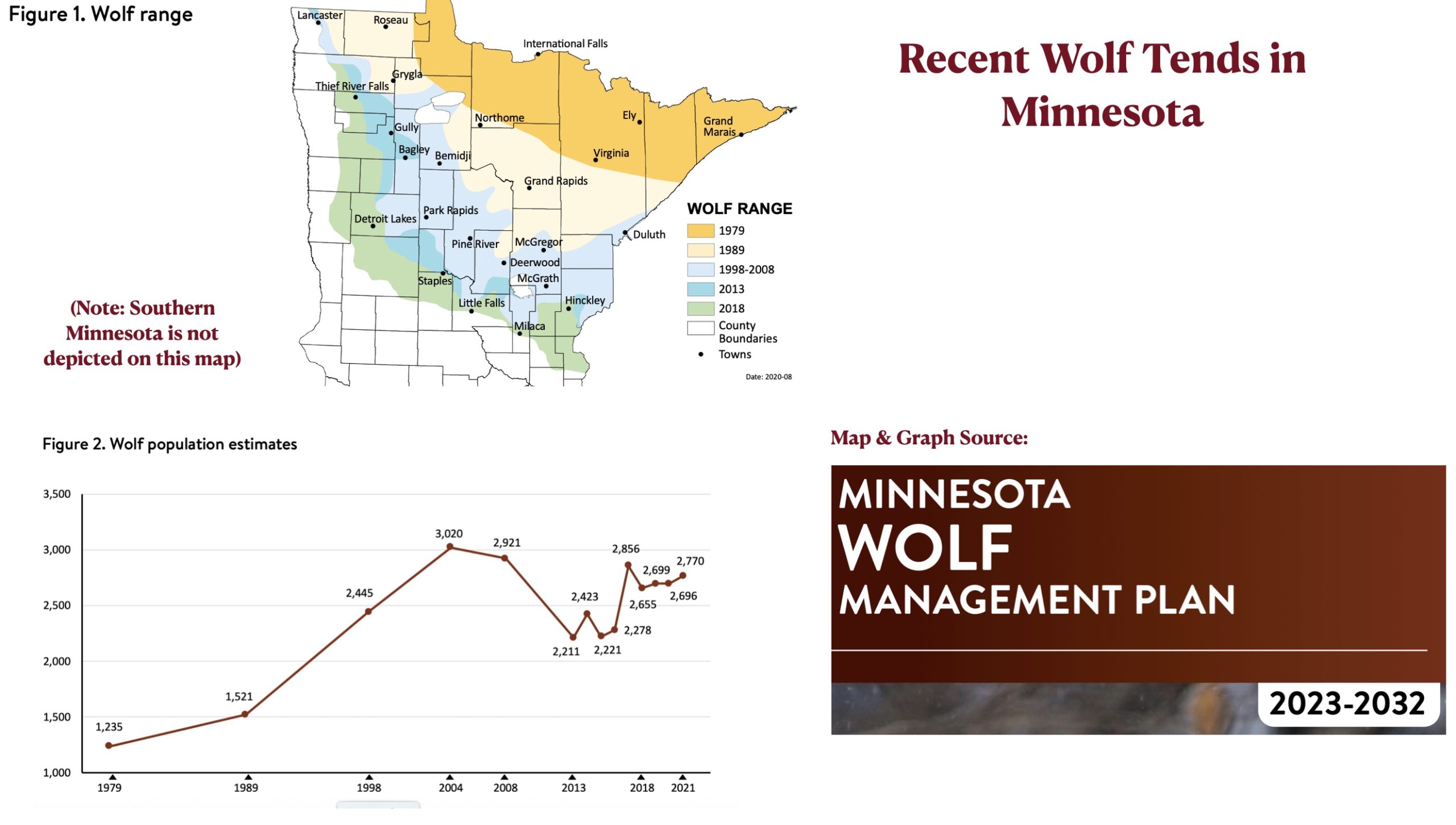
The wolf-reduction plans of Montana and Idaho are characteristic of the more conservative attitudes found in these Republican-voting, or “red,” states. As a left-leaning (if purple-trending) state, Minnesota is taking a different path. “Objective 1B” of its current management plan is to “maintain a population comparable to recent estimates (2,300-3,000, well above the federal recovery goals) and distributed across the majority of current wolf range.” Intriguingly, although wolf numbers in Minnesota have declined slightly since 2004, the species’ range in the state has continued to expand, as demonstrated by the figure posted below.
Although the current wolf policies of Montana and Idaho seem harsh when compared to that of Minnesota, they seem positively pro-wolf when compared to that of Sweden, a country with a strong “green” reputation. As noted in the previous post, Sweden intends to reduce its wolf population from roughly 400 to only 170, whereas Idaho has set a far more robust target population of 500. Sweden, moreover, is almost twice as large an Idaho (173,860 sq mi vs. 83,571 sq mi), and a larger percentage of its land is potential wolf habitat.