
As I was preparing to resume posting on GeoCurrents after a short hiatus, I decided to examine recent posts on the fascinating but unfortunately named Reddit site called “MapPorn.” As always, I was struck by many contributions, but what really caught my eye was a five-map sequence on the decline and resurgence of the grey wolf in Italy. I have simplified this map sequence and posted it below.
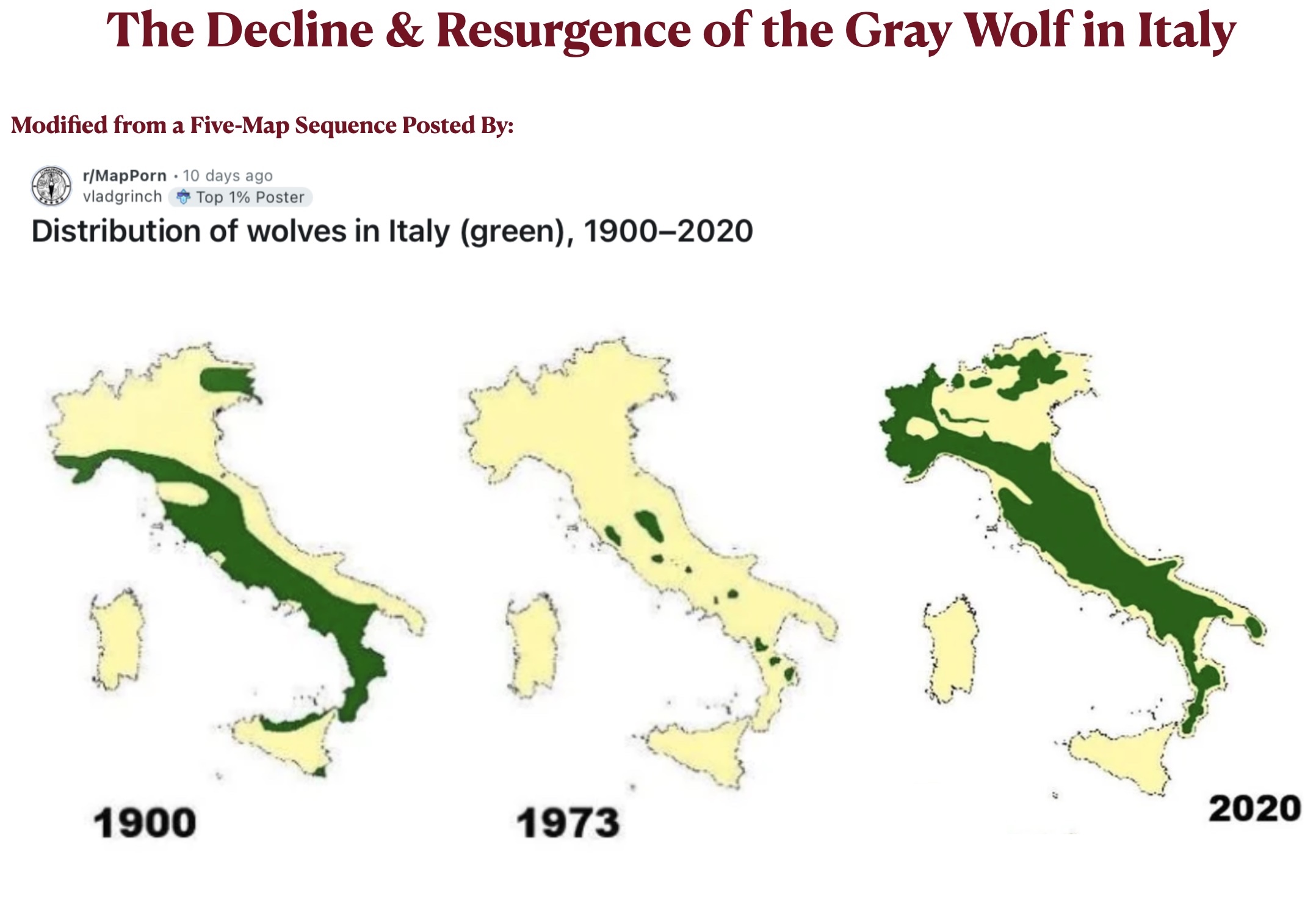
The story that these three maps tell is familiar but rarely illustrated so clearly. In most developed countries, the ranges of most large mammals retreated drastically in the early 1900s before readvancing a century later. As can be seen, wolves were widely distributed in Italy in 1900 but had been virtually extirpated in 1973; by 2020, however, they occupied a larger area than they had 120 years earlier. Wolves have not, however, returned to Sicily, which would entail crossing the perilous Strait of Messina. The core wolf territory in all three periods was the Apennine Mountains of the central peninsula. Intriguingly, the Alps appear to have been essentially without wolves in 1900 and still have relatively few packs. (I have no way to assess the accuracy of these maps, but I do suspect that ranges are somewhat exaggerated on both the 1900 and 2020 maps; the fact that all coastal regions are depicted as wolf-free in 2020 but not in 1900 strikes me as odd.)
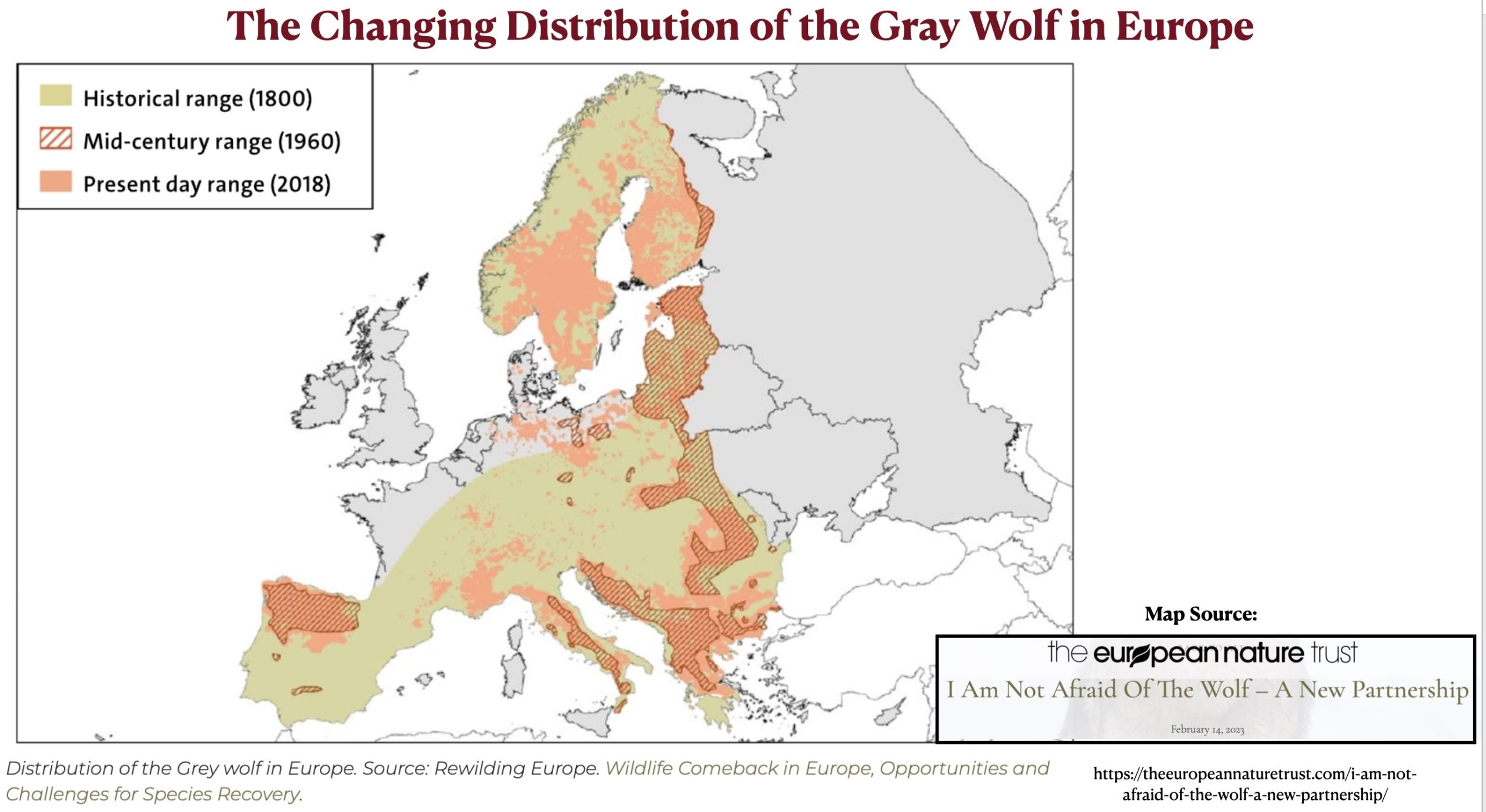
A similar story of wolf decline followed by resurgence can be told for other parts of Europe, as indicated by the map posted below. As can be seen, wolves had been eliminated from much of northwestern Europe by 1800. Most sources claim that England’s last wolf was killed around 1500, and that by the late 1600s the species was extinct in Scotland as well. By the mid 20th century, wolves had been wiped out almost everywhere in Western Europe, with remnant populations found only in northwestern Iberia in central Italy. Yet as this map also shows, viable wolf populations remained at the time in large areas of eastern, central, and southeastern Europe, mostly in what was then the communist zone, including East Germany. This was less a matter of preservation in the east than of less effective eradication efforts.
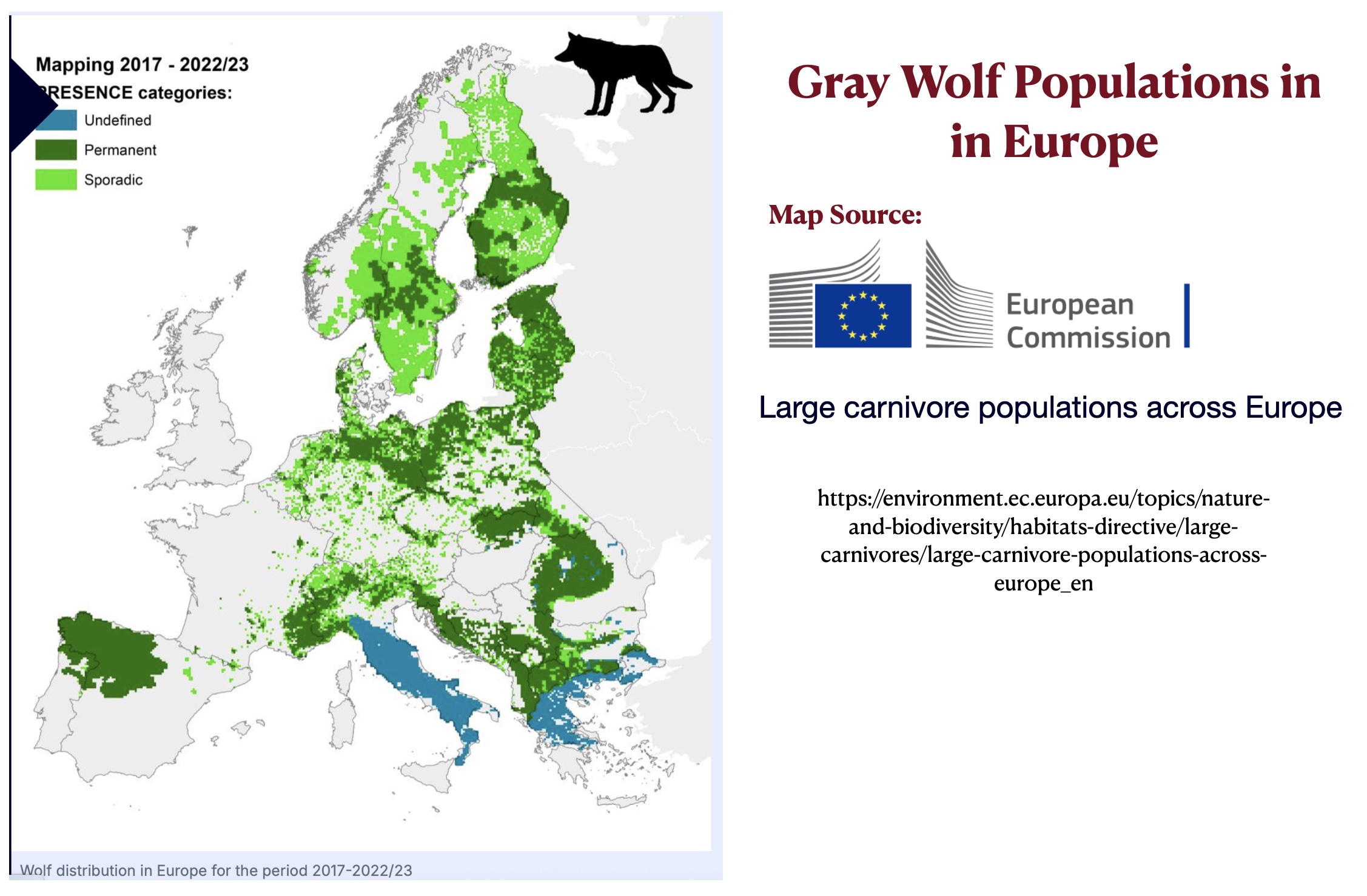
Wolf populations began to rebound and expand in Western Europe with the growth of environmentalism in the late 20th century. As the next map shows, secure wolf populations are now found in southeastern France, across most of the Nordic countries, and in northern Germany. In southern Europe, wolves are found mostly in mountainous areas (but note the species’ general absence in the Pyrenees). In northern Europe, in contrast, wolves appear to be more widespread in lowland areas. Although wolves were not seen in the Netherlands – the lowest of the Low Countries – until 2015, the country had an estimated 63 individuals in September 2023, with another 28 in neighboring Belgium. I find it remarkable that the Netherlands now supports wild wolf packs, considering its high population density, intensive agriculture, and subdued topography.
The return of the wolf has generated intense controversies in Europe, as it has in the United States (as we shall see in a later post). Farmers are furious at the depredation of their livestock herds, and some rural people worry that wolves may become a danger to humans if they grow too numerous. In 2023, the government of Sweden decided to address such concerns by reducing the number of wolves in the country from more than 400 to a target population of some 170. Not surprisingly, this move has encountered widespread opposition from environmental groups, which argue that the reduction of the wolf population threatens ecosystem integrity. Animal-rights activists also oppose wolf hunting, favoring non-lethal methods of protecting livestock. Such controversies are increasingly encountered across much of Europe. In early 2025, the Berne Convention, which guides Wildlife Conservation in Europe, downgraded the status of wolves from “strictly protected” to “protected.”